USA
USA  United Kingdom
These days it’s not merely enough to develop a cohesive people strategy. It also needs a label that travels well across an organization, resonates internally, and signals clearly where leadership thinks the future of work is heading.
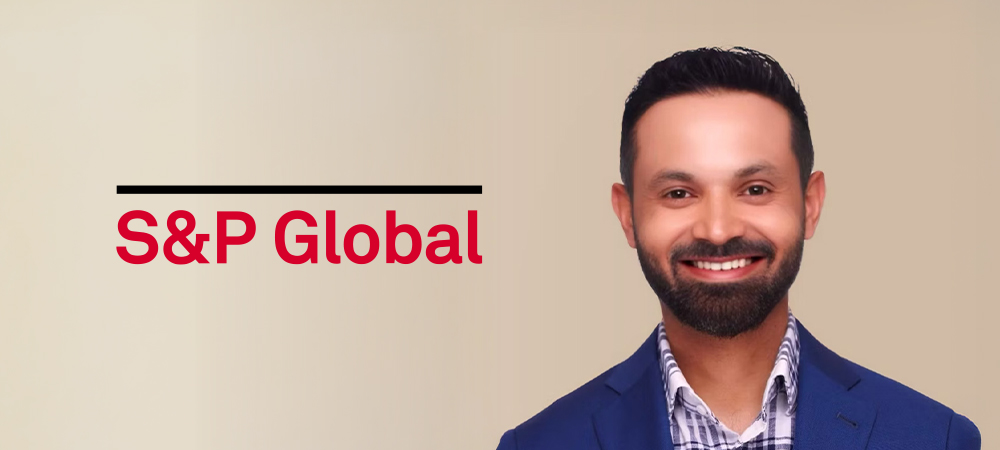
At S&P Global, that label is People Forward. For Girish Ganesan, Chief People Officer at the global financial information and analytics giant, the phrase represents a deliberate shift in how people strategy interacts with business strategy, culture, and technology.
It is designed to place workforce capability directly at the center of the company’s growth ambitions.
“We wanted to make sure that as the world is changing around us, we were truly empowering our people to drive their own growth and careers. We'll provide the support that they need, both personally and professionally. So, it isn't just a slogan, it’s embedded in everything we do, from how we design our benefits to how we promote internal mobility. It's backed by insights, leadership, accountability, and real investment in our people.”
Expanding on what that really means, and what distinguishes the strategy from the familiar “people-first” rhetoric that has populated corporate presentations for years, he says: “It's about unlocking potential at scale and helping our people reach their full growth potential through access to learning, career mobility and meaningful work. And we are making all the right investments around that in order to make it easy for our people.”
Unlocking potential at scale
Unlocking potential is the organizing principle behind a framework that attempts to align engagement, learning, and performance into something measurable and commercially relevant.
The S&P framework rests on three pillars, each intended to connect culture directly to outcomes.
“It's also about creating connectivity because engagement fuels innovation and client impact. So we wanted to make sure that our people feel connected to the organization, but also to each other, particularly in the world that we are living in, where there's so much polarization. And the third was clear linkage of people outcomes to business outcomes so that it wasn't just treated as an HR initiative, but truly linked to business performance.”
It is connected to skill-based career mobility that is focused on AI learning that we're doing at scale for all employees
What that means in practice is that People Forward is not confined to the HR department. Instead, it is designed to surface in programs that operate across the entire workforce, from leadership development and career mobility to AI capability and community engagement.
Given S&P Global’s global footprint it needs to work at scale.
“It is connected to skill-based career mobility that is focused on AI learning that we're doing at scale for all employees, 40,000 of them in 41 countries and leadership development at scale. We're also focused on taking this outside of four walls through community investments, through philanthropic efforts on youth development, and finally, a focus on well being that's embedded in our employee experience.”
Although the strategy now sits at the heart of the organization’s cultural narrative, the shift itself is relatively recent. The timing reflects a broader enterprise reset that coincided with leadership changes at the very top of the company about 18 months ago.
“We made this shift from people first to People Forward when we did the CEO transition in 2024. And part of that was coming up with a new enterprise strategy, which was published as part of Investor Day last November, but also a new employee value proposition and workforce strategy.”
Big Interview | Why the CIA needed a Chief Wellbeing Officer
In many organizations, that kind of strategic repositioning can take the better part of a year or longer to shape and communicate. At S&P Global, the timetable was considerably tighter.
“Our leadership team moves at pace. So we came up with this in three months. And our CEO was very clear when she was announcing her new leadership team and the timeline that was put in place to come up with the new work enterprise strategy for Investor Day, the workforce strategy had to be ready at the same time.”
Speed of execution is one thing, but cultural adoption is another. Replacing a long-standing internal narrative requires careful messaging, particularly when employees have lived with the previous framework for years.
That meant careful and deliberate change management.
“It was very important because it reinforced the focus on humans in our workforce. The shift from ‘First’ to ‘Forward’ required change management because people first had existed in the organization for almost seven years. And so we had to come up with the right campaign around it as to why we made the shift and what this meant. And now it just rolls off tongue for a lot of our people, because they get that this is really about making sure we are adapting to the changing environment around us.”
Early engagement data suggests the message is resonating internally, something HR leaders often struggle to measure when such new frameworks are introduced.
“One of the things that we pride ourselves in is our engagement survey. There's a question around, ‘why I’m proud to work at S&P Global’, and it was 90% favorable across our entire population. That was done in December of last year, which is a testament to how we are mobilizing as an organization and how our employees feel about our brand and the employee value proposition.”
External validation has followed as well, reinforcing the internal narrative that the company’s cultural investment is landing with its workforce.
“We just announced that S&P Global was recognized as a number one company by Fortune’s globally most admired companies. We were number one in financial data services.”

AI democratization and skills focus
If People Forward provides the cultural framework, artificial intelligence is the enabler currently being scaled across the organization through a nearly $1bn investment.
S&P Global’s approach to AI is not limited to technology deployment. The emphasis is on workforce enablement, ensuring employees across the company have the skills and confidence to use emerging tools.
“A defining feature of our S&P global strategy from an AI perspective is deliberate democratization of AI capability. That's why we launched our Spark AI Academy and Enterprise Learning. Spark AI Academy was designed to upskill the entire global workforce. And we paired it with mandatory AI learning for everyone, but a balance of human skills and technical skills so that the human skills weren't being lost.”
The rollout follows a phased model designed to build both understanding and adoption across the workforce. The objective is to move AI from curiosity to an everyday tool in widespread use.
“I describe it with three A's. It was about access, application, and acceleration. And where we are at is in the second phase, which is application. First, it was about providing access to everybody around what is this technology about, and how do we train you so that you can actually make meaningful use of it? And now we're in the application stage where we have started to see automation of certain workflows, augmentation of certain work that can be done through AI. But it's manifesting in different ways depending upon how complex the workflow and the process is.”
We've invested close to about a billion dollars in AI deployment across the organization already
In practical terms, it has already translated into widespread adoption inside the company’s internal systems.
“When we launch the AI Academy for all 40,000 people, we campaigned that as AI is going to be a new life skill, and we want all of you to have the foundational learning around AI so that you are equipped to be able to lead forward. That then resulted in every single employee having access to the internal Gen AI experimentation platform - Spark Assist - which is now being used by all 40,000 employees, and it's generated about 3,000 reusable prompts.”
The technology push is not a small experiment. S&P has committed significant capital to the initiative as it attempts to integrate AI into workflows and products across the business.
“We've invested close to about a billion dollars in AI deployment across the organization already, and it's manifesting itself in many different places. But we still have a lot to do.”
Part of that investment also reflects a broader shift toward skills-based workforce design, an approach increasingly adopted by large organizations seeking to improve mobility and redeployment.
Turning workforce data into early warnings for high-cost employees
“We announced a partnership with Eightfold AI to implement a new talent marketplace which is going to help us shift from being the job-focused organization to a more skill-focused organization.”
But even the most sophisticated technology strategy ultimately depends on leadership capability. Ganesan is clear that people leaders play a crucial role in translating transformation into daily behavior.
“We are in the process of designing a change in leadership academy that every single people leader is going to go through so that they are equipped to operate with agility and lead this organization forward because they are the ones in the forefront of leading the transformation that we are aspiring for.”
Of course, for employees, the rapid acceleration of AI inevitably brings uncertainty and fears around job insecurity. Managing that emotional response, Ganesan suggests, is as important as deploying the technology itself.
“I think we have to be honest with ourselves that they will always be nervousness through uncertainty. There's so much that is coming at us with tech transformation, particularly with generative AI and the speed it's moving. But I think the noise and certainty and the confidence in the workforce is largely through how you manage change.
“Our overall strategy from an AI perspective is largely been about augmentational work. And figuring out what new jobs are going to emerge as a result, so that we can actively redeploy our people through the reskilling.”
People and social investment
Even with the progress made so far, the to-do list remains long. Technological evolution, governance compliance, and global complexity all sit firmly on the leadership agenda.
“AI is definitely at the forefront and top of mind for us. But beyond that, it is making sure that we are keeping up and have robust governance in place in terms of both responsible adoption but also cybersecurity, given the nature of our business.”
We also don't want to be one of those organizations that doesn't believe in youth development and young talent from a workforce strategy perspective
Despite the focus on AI transformation, Ganesan insists the company’s workforce strategy must extend beyond current employees and continue to invest in future talent.
“We also don't want to be one of those organizations that doesn't believe in youth development and young talent from a workforce strategy perspective. So we're still hiring interns, we're still hiring early career professionals because we do believe that they have the agility and the real reskilling and learning ability that we can capitalize to our advantage.”
That commitment now extends into broader social investment as well.
“We launched a $10million investment earlier this year that we're going to invest in over three years with not for profits across the globe that are going to focus on youth development, largely that are investing in AI upskilling.”
People Forward then, other than being a catchy buzzword, is the belief that organizational performance increasingly depends on how effectively companies can combine human intelligence with artificial intelligence, without losing sight of the people who make the system work.